


TSUKUBA ALUMNI
FUKUHARA Yusaku
College of International Studies, School of Social and International Studies (2016)
Addressing Peace and Security Challenges as a Scholar and a Practitioner
Second Secretary, Embassy of Japan in Ukraine
FUKUHARA Yusaku
Life Lessons Learned at the University of Tsukuba that Shaped My Career and Life
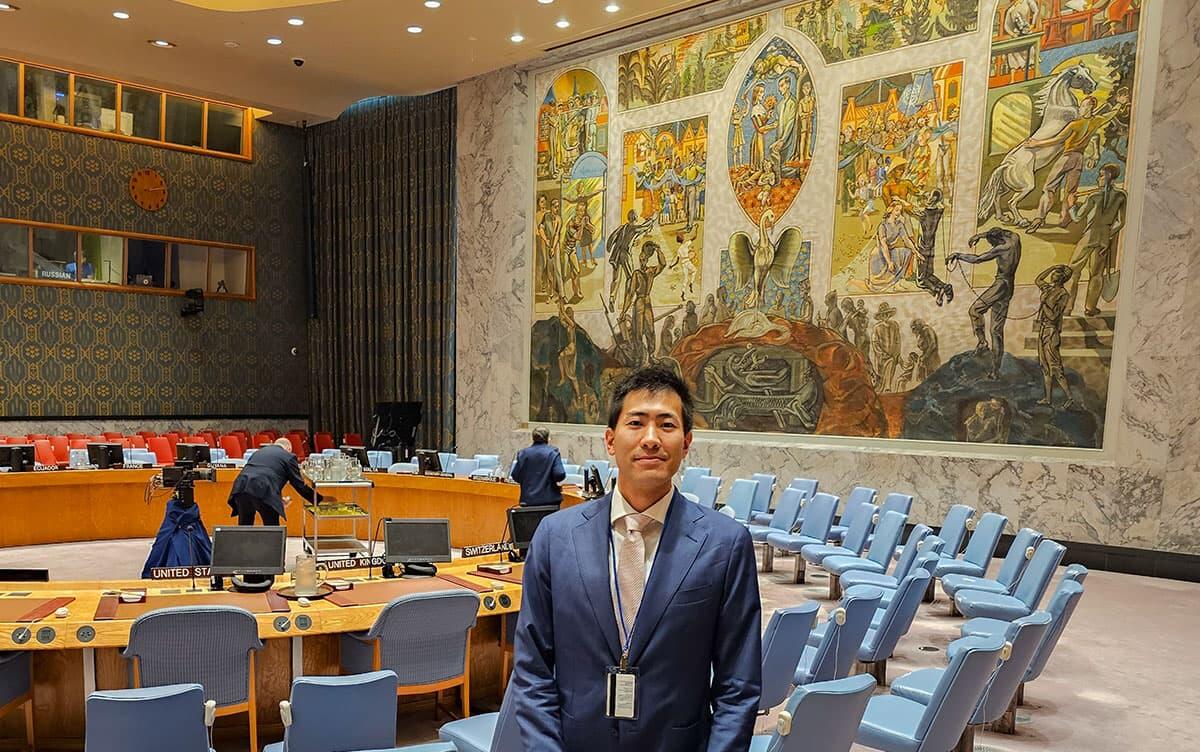
I am currently serving in the Political Affairs Section of the Embassy of Japan in Kyiv, Ukraine. Previously, I served in the Secretariat of the United Nations while working on my Ph.D. thesis, which I finished in 2025. In that sense, I am both a political scientist and a diplomat. Although balancing the roles of scholar and civil servant can be challenging, I have avoided losing either perspective in my work, whether in academia or diplomacy. In the real world, politics and diplomacy do not always unfold as theory suggests, and I remain conscious of the gap between theory and practice.
In high school, I remained on the science track until my final year because I wanted to become an astronaut. However, a geography teacher changed the course of my life. He was an exceptionally effective teacher, and his classes sparked my fascination with foreign cultures, histories, and political and economic systems. Determined to study international relations, a field in which all these elements converge, I enrolled at the University of Tsukuba, one of the few universities in Japan at the time with a faculty specialising in international relations.
At the University of Tsukuba, I specialised in Russian politics under the guidance of Professor Itsuro Nakamura, a distinguished scholar of the Soviet Union and Russia. I was particularly influenced by his fieldwork-based approach to research, which placed a strong emphasis on empirical evidence and the careful examination of political realities on the ground. His approach taught me the importance of grounding political analysis not only in theoretical frameworks but also in firsthand observations and concrete evidence.
In the winter of my junior year, while I was in the midst of my job search, a major event dramatically reshaped the international political landscape: Russia's annexation of Crimea. The development immediately sparked my interest in Ukraine and prompted me to think more deeply about the complex political dynamics of the region. At the time, I was already researching Russian-speaking populations in the Baltic states for my graduation thesis. Rather than abandoning the research I had already undertaken, I decided to continue with my original topic while broadening my perspective on the region. I ultimately chose Estonia as my destination for an exchange programme. I thoroughly enjoyed my studies and the many encounters I had with wonderful people in Estonia. Over time, Estonia became a second home, and the experience left a lasting impression on my personal and intellectual development.
Above all, what impressed me most about the University of Tsukuba was its remarkable diversity. The campus brought together people from extraordinarily diverse backgrounds, including international students, Olympic athletes, scientists, artists, and researchers from various disciplines. Being surrounded by people whose experiences, interests, and perspectives greatly differed from my own encouraged me to look beyond the boundaries of my academic specialisation. It challenged me to approach questions from unfamiliar perspectives and to recognise the value of intellectual curiosity beyond one's immediate field, which made my university years especially stimulating and memorable.
My Fondest Memories as a Student
While studying international relations at the University of Tsukuba, I developed an interest in Christianity because of its deep historical relationship with Western political thought. Once or twice a week, I met with American Catholic priests to discuss different interpretations of the Bible. These conversations provided an opportunity to explore questions that extended well beyond the study of religion and to consider history, culture, and political thought from perspectives that complemented and enriched what I was learning in the classroom and through academic literature. These encounters encouraged me to think critically about how ideas and traditions develop across societies and how they continue to shape contemporary political life.
Another particularly formative experience occurred in 2014 when the group organised a study trip to the Philippines to participate in volunteer activities in a large area affected by a devastating typhoon Haiyan, also known as Typhoon Yolanda. There, I directly interacted with local communities and saw how living conditions could profoundly shape people's opportunities and experiences. I witnessed firsthand how differences in birthplace and living circumstances can result in significant disparities in people's lives. This experience profoundly affected me and fundamentally changed the way I viewed the world.
Message to Students of the University of Tsukuba
I encourage students to look beyond their immediate surroundings and approach the world with as broad and open a perspective as possible. It is easy to become preoccupied with efficiency, practicality, or others' expectations. However, university is also a unique period in life during which we have the freedom to explore freely, without having to define every experience in terms of its immediate usefulness. If you discover something that genuinely captures your interest and find a subject, activity, or cause to which you can devote yourself wholeheartedly, even if only for a particular period of your life, that experience can become deeply meaningful and may continue to influence you long after graduation.
Choosing a path that differs from those around you can be unsettling, especially when there is no guarantee that your decision will produce an obvious or certain outcome. Nevertheless, remaining faithful to your convictions and pursuing your goals with perseverance can help you develop a unique identity and perspective that are uniquely your own. Not every meaningful experience must have an immediate or clearly defined practical outcome. Sometimes, experiences that initially seem uncertain or unconventional become the ones that shape us most deeply.
At the same time, pursuing one's own path does not mean isolating yourself from others or becoming closed to perspectives that differ from your own. Openness, curiosity, and communication are particularly important in multicultural environments. By listening to people from different backgrounds, taking the time to understand them through their words and actions, and showing genuine interest in their experiences, we can expand our understanding of the world and develop relationships that transcend cultural and disciplinary boundaries.
My time at the University of Tsukuba taught me that education extends far beyond what can be learned within a classroom. It is also about encountering people and ideas that challenge our assumptions, engaging with experiences that broaden our horizons, and having the courage to pursue questions that genuinely matter to us. I hope that students at Tsukuba will make the most of that freedom and allow their university years to become a period of exploration, discovery, and personal growth.
PROFILE FUKUHARA Yusaku
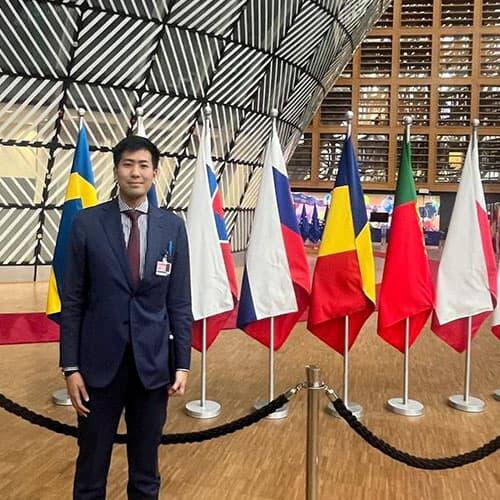
Born in Gunma Prefecture, Japan
Graduated from the College of International Studies, School of Social and International Studies(BA in International Relations), 2026
Second Secretary, Embassy of Japan in Ukraine